Volunteers Are Crucial for NPS and other Land Managers
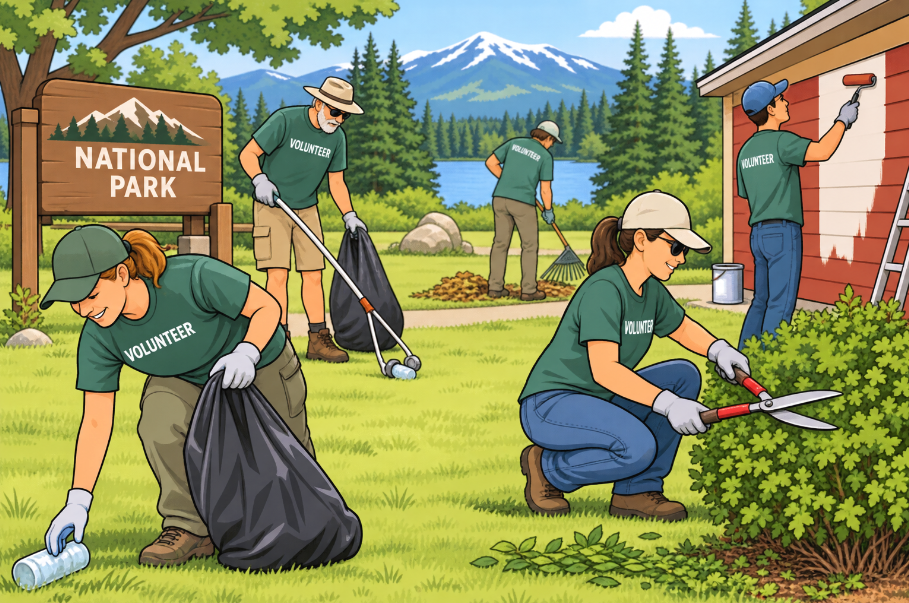 Volunteers provide an extraordinary contribution to the stewardship of America’s public lands. In 2023, approximately 280,000 volunteers contributed 10 million hours of service across federal land-management agencies: the National Park Service, Forest Service, Bureau of Land Management, Fish and Wildlife Service, US Geological Survey, and Army Corps of Engineers, representing an estimated value of $334 million. In addition, volunteers contributed to state, county and local government agencies. Their work ranges from maintaining trails, cleaning campgrounds and removing trash to restoring historic structures, monitoring wildlife, conducting scientific surveys, and educating visitors. Many are motivated by a personal love of the outdoors, a sense of responsibility, and the satisfaction of giving back to places they value.
Increasingly, however, volunteers and nonprofit organizations are taking on responsibilities that agencies lack the staffing and funding to handle. For example, the Missoula Mountain Bike Coalition, with just three paid employees and approximately 175 volunteers, has assumed much of the trail-building and maintenance work in parts of the Lolo National Forest. These partnerships are valuable, but they also reflect chronic understaffing within federal agencies.
Recent federal workforce reductions make the situation more concerning. Since President Donald Trump took offce in 2025, an aggressive round of firings, buyouts, and encouraged retirements has slashed the NPS’s permanent staff by 24 percent, while the Forest Service has lost nearly 6,000 employees, or 16 percent of its workforce. Although volunteers can help compensate for some of the lost capacity, they cannot replace trained professionals. They need agency employees to establish priorities, provide training, coordinate projects, and ensure that work meets agency standards and objectives.
The consequences of employee cuts are already apparent. During a recent government shutdown, a volunteer wildlife-monitoring program in Montana came to a halt because the federal employee responsible for coordinating volunteers was furloughed. The volunteers were ready and willing to work, but without professional coordination, the program could not function. If we’re talking about DOGE [the Department of Government Efficiency], the last thing you want to do is cut a job that coordinates volunteers.
The central message is that volunteers are an invaluable supplement to public-land employees, not a substitute for them. Cutting the professional workforce ultimately undermines the very volunteer programs that help agencies accomplish their missions. Just as importantly, volunteering creates a personal connection to public lands and a sense of ownership that encourages people to support and protect them. Maintaining a strong, professional agency workforce is therefore essential not only to managing public lands today, but also to sustaining the volunteer commitment on which their future increasingly depends.
This is a condensation of an article in the Fall 2026 Sierra Magazine by Elisabeth Kwak-Hefferan.

0 Comments